


119 concrete actions to advance inclusion, independence, and participation for people with disabilities
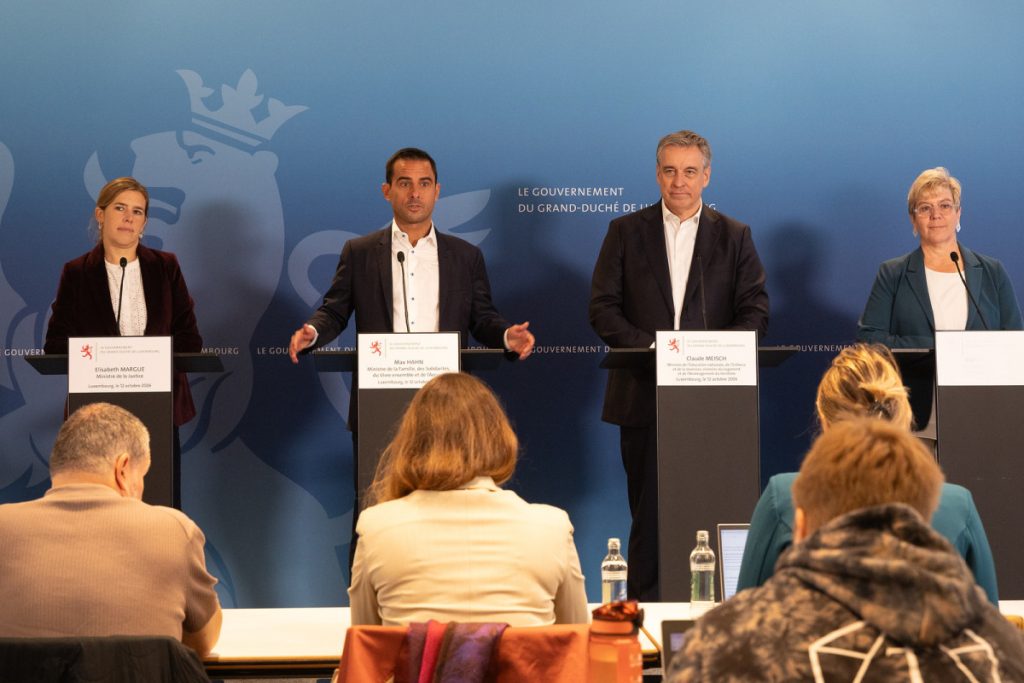
On October 12, 2026, the Minister of Family, Solidarity, Community Life, and Immigration, Max Hahn; the Minister of Justice, Elisabeth Margue; the Minister of National Education, Children, and Youth, and Minister of Housing and Land Use Planning, Claude Meisch; and the Minister of Health and Social Security, Martine Deprez, presented the third National Action Plan for the Implementation of the Convention on the Rights of Persons with Disabilities (PAN CRDPH).
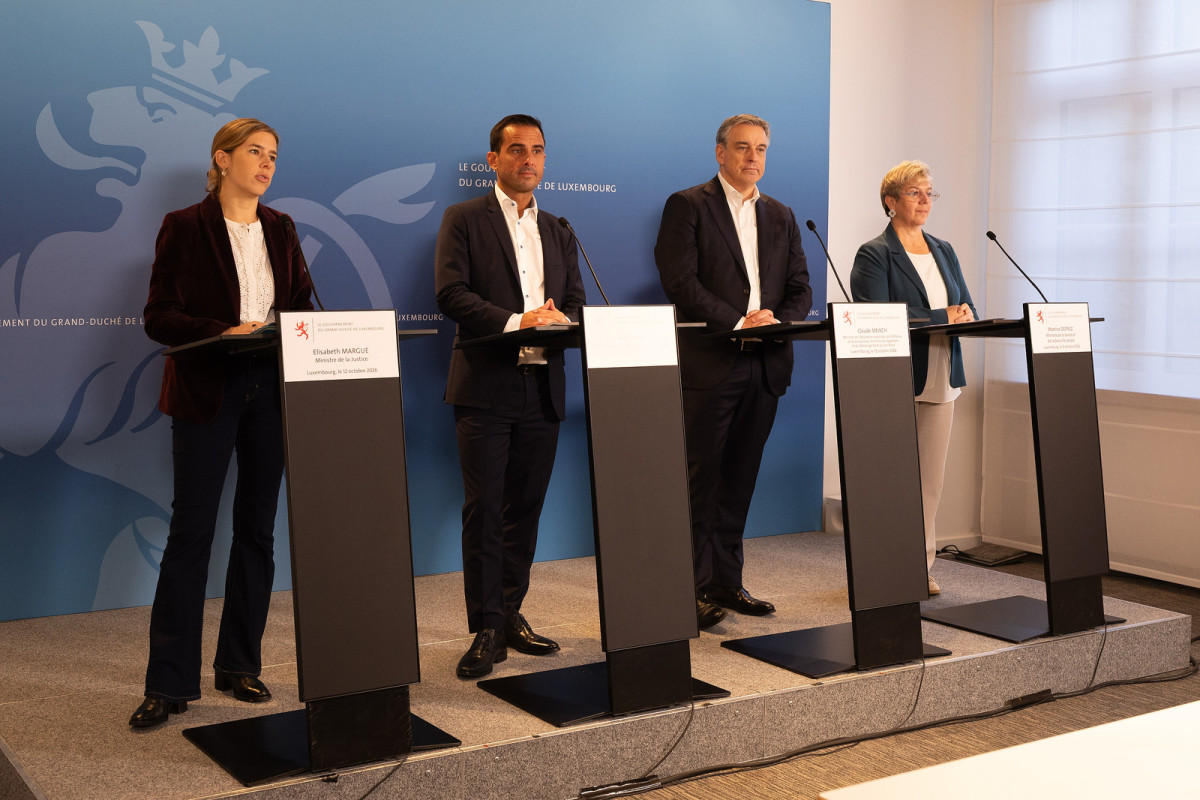
(from left to right) Elisabeth Margue, Minister of Justice; Max Hahn, Minister of Family, Solidarity, Community Life, and Immigration; Claude Meisch, Minister of National Education, Children, and Youth, and Minister of Housing and Land Use Planning; Martine Deprez, Minister of Health and Social Security.
With 50 goals and 119 concrete actions, this new plan continues Luxembourg’s commitment to an inclusive society based on human rights, equality, non-discrimination, autonomy, and the full participation of people with disabilities.
The new National Action Plan (PAN) is not just a plan developed by the Ministry of Family, Solidarity, Community Life, and Immigration. It is a government-wide action plan involving all 20 ministries.
“The fact that all 20 ministries are represented in this plan underscores that inclusion is a cross-cutting and essential issue that affects all areas of life. Ensuring the rights of people with disabilities is a shared responsibility of the entire government,” emphasizes Max Hahn, Minister of Family, Solidarity, Community Life, and Hospitality.
Continue to implement the United Nations Convention
Luxembourg ratified the United Nations Convention on the Rights of Persons with Disabilities in 2011. The new National Action Plan builds on the 2012–2017 and 2019–2024 action plans, while taking into account the lessons learned from the evaluation of the previous plan as well as the observations and recommendations of the United Nations Committee on the Rights of Persons with Disabilities.
According to the 2021 census, 14.6% of the population residing in Luxembourg—more than 94,000 people—reported living with a disability.
Despite the progress made in recent years—particularly in the areas of legislation, accessibility, governance, and awareness—physical, digital, communication-related, institutional, and societal barriers remain.
"Nothing about us without us"
The participation of those directly affected was a central element in the development of the new National Action Plan, in accordance with the principle “Nothing about us without us.”
Two large participatory workshops were held in October 2025, each bringing together more than 150 participants representing people with disabilities, civil society, and the professional sector. Info-Handicap, the High Council for People with Disabilities, and GroSuivi PAN were also involved in the process.
However, this involvement does not end with the development of the plan. It will continue throughout its implementation.
GroSuivi PAN: A Key Role in Monitoring and Tracking
Special attention is given to governance and oversight of the implementation of the various initiatives.
In this regard, the National Action Plan Monitoring Group (GroSuivi) plays a vital role as an external, participatory monitoring and oversight body. It brings together those directly affected, civil society organizations, and the three independent human rights mechanisms: the Center for Equal Treatment (CET), the Consultative Commission on Human Rights (CCDH), and the Ombudsman.
GroSuivi thus provides an outside perspective on the progress of the National Action Plan (NAP), allows for the sharing of the experiences and needs of those affected, and offers critical and constructive support for its implementation.
This structure complements the work of the Interministerial Committee, in which the 20 ministries are represented and which ensures operational coordination among the various ministerial departments.
The Ministry of Family, Solidarity, Community Life, and Immigration is responsible for overall coordination. A progress report on implementation will be prepared annually, and an external evaluation is scheduled after five years.
50 goals and 119 concrete actions
The new National Action Plan includes a chapter on governance and seven thematic areas:
- equality and non-discrimination,
- accessibility and participation in society,
- "autonomy and self-determination,"
- education, childhood, and youth,
- health, social security, rehabilitation, and care,
- work and employment,
- international cooperation.
The planned measures include, in particular, the creation of a one-stop shop for people with disabilities, the expansion of personal assistance and individual budgets, and the reform of guardianship laws.
In the field of education, the National Action Plan (NAP) aims, in particular, to strengthen cooperation between formal and non-formal education, to expand educational opportunities for students with behavioral disorders, to reform decision-making bodies, and to provide better support for newly arrived students with special needs and their families.
In the area of health care, the measures aim to ensure that everyone has equitable access to quality care tailored to their needs. The measures proposed as part of this plan aim to improve information and communication regarding care pathways, ensure adequate training for all healthcare professionals, and ultimately promote and implement better access to prevention and screening. Particular emphasis is placed on strengthening the care pathway for individuals with neurodevelopmental disorders.
In the area of labor and employment, the plan calls, in particular, for reform of the status of employees with disabilities and inclusion assistants. It also aims to improve access to employment and training for people with disabilities through reasonable accommodations during recruitment, training, and civil service examinations.
International cooperation, for its part, is a field in its own right. The National Action Plan (NAP) calls, in particular, for greater consideration of the rights and needs of people with disabilities in development cooperation and humanitarian aid.
A dynamic, evolving plan
Unlike its predecessors, the new National Action Plan (NAP) is designed as a multi-year, evolving plan. It can be adapted as it is implemented to take into account new needs, feedback from partners, and the progress of the various actions.
This approach should help make the National Action Plan a dynamic document, the implementation of which can evolve in response to the realities encountered on the ground.
The goal is to continue removing barriers and enable every person, with or without a disability, to participate fully and on an equal footing in all areas of society.
With this third National Action Plan, the government is continuing the practical implementation of the United Nations Convention on the Rights of Persons with Disabilities.
The full text of the Action Plan is available at: www.planhandicap.public.lu.
Press release issued by: Ministry of Family, Solidarity, Community Life, and Immigration / Ministry of Justice / Ministry of National Education, Children, and Youth / Ministry of Housing and Land Use Planning / Ministry of Health and Social Security